Why India’s Rs 900-crore festive creator market is moving beyond discovery
Brands are raising festive creator spends, but with influencer discovery getting crowded, focus is shifting from reach to relevance, regional influence & trusted voices that drive purchase decisions
 by
by
Published: Aug 29, 2026 8:52 AM | 7 min read
 Follow Us

- India's festive creator marketing market is projected to reach ₹900 crore in 2023, a 29% increase from ₹700 crore in 2022, with around 7,200 brands expected to engage creators during the festive season, according to Qoruz data.
- Brands are shifting their focus from traditional celebrity endorsements to regional voices and smaller creators, as consumer preferences evolve towards premium and curated products, with a notable rise in demand for items like premium Rakhis and jewelry.
- The top 10-15% of brands are anticipated to account for nearly 65% of the festive creator marketing expenditure, while nano and micro creators represent 75% of participation, indicating a trend towards localized and community-focused marketing strategies.
- Research indicates that while creator content aids in product discovery, purchase decisions are increasingly influenced by validation from trusted individuals, highlighting the importance of integrating creator marketing with consumer trust dynamics.
India’s festive creator marketing market is expected to touch ₹900 crore this year, up nearly 29% from ₹700 crore in 2025, with around 7,200 brands expected to activate creators during the season, as per Qoruz data. Behind the sharp rise in spending is a more important shift: brands are increasingly asking not just whether creators can generate discovery, but whether that discovery can translate into consideration, conversation, and ultimately, a purchase.
The change comes as festive consumption itself becomes more fragmented. Consumers are shopping earlier, moving across multiple festive occasions and increasingly looking beyond metros for products, recommendations and gifting ideas. For marketers, this is pushing creator campaigns away from the traditional celebrity-led, Diwali-heavy playbook toward regional voices, smaller communities and content that can influence consumers throughout the purchase journey.
The shift is already visible in festive consumption. Swiggy Instamart, for instance, reported a 20-fold rise in demand for premium Rakhis compared with last year, with consumers showing greater interest in silver and jewellery-inspired designs. Searches for jewellery brands have also risen, suggesting that festive gifting is becoming more considered and premium rather than being limited to traditional products.
Read On: Why brands are backing creators with distinctive content styles
Gautam Swaroop, Chief Business Officer, Instamart, said the platform is seeing consumers respond strongly to a wider assortment of premium and curated products as their needs, preferences and occasions evolve. “As consumers’ needs, preferences and occasions continue to evolve, we’ve built Instamart to offer a broader and more differentiated selection, from everyday essentials to premium and curated products. We’re seeing strong consumer response to our premium offerings, reflecting a growing appetite for greater choice and discovery. This is at the heart of our Switch to Better proposition, as we continue to deepen these segments and make Instamart a destination that can cater to every kind of need and occasion.”
That premiumisation is happening alongside a broader expansion of creator-led marketing.
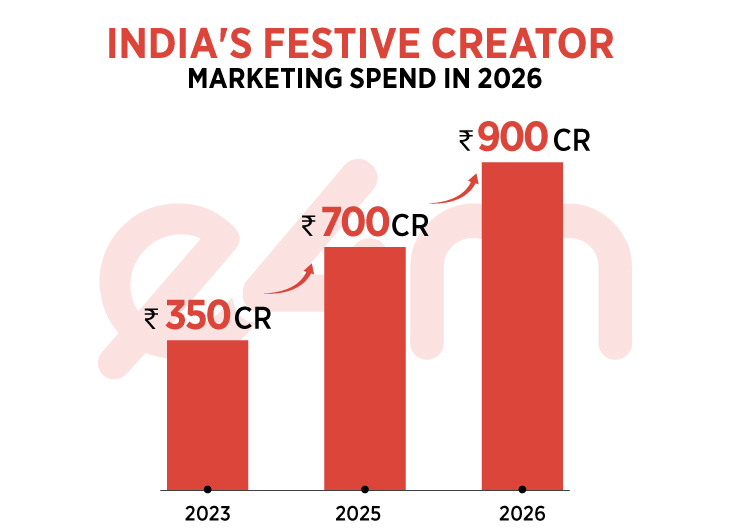
Qoruz estimates that festive creator spending has grown from ₹350 crore in 2023 to the projected ₹900 crore this year, translating into a CAGR of around 37%. The number of brands participating has also risen from 4,500 in 2023 to an expected 7,200 this year.
However, spending is not spreading evenly across advertisers. The top 10-15% of participating brands are expected to account for nearly 65% of festive creator marketing expenditure, meaning a relatively small group of advertisers is driving a disproportionate share of the market. At the same time, execution is becoming increasingly distributed across smaller creators.
Read On: The end of dubbed festive ads? Brands embrace hyperlocal storytelling by regional creators
Praanesh Bhuvaneswar, Co-Founder and CEO, Qoruz, said, “As brands increase their creator marketing budgets, many may look beyond the usual names this festive season. The opportunity lies in finding creators who can bring a fresh voice to campaigns and help brands stand out. Along with performance, brands should also consider how often a creator’s audience sees branded content and how many competing brands that creator worked with during the last festive season. Finding relevant creators who are not already crowded with competing brand campaigns could become an important part of festive campaign planning.”
Nano and micro creators accounted for 75% of festive creator participation last season, while mega creators and A-list celebrities accounted for only 5%. Creators from Tier 2 and Tier 3 markets contributed 38% of festive campaign activity, compared with 62% from metros.
For Sumit Gupta, Founder, Viral Pitch, this represents a structural change in how brands treat creator marketing.
Gupta said brands are increasing festive creator budgets by 30-40% year-on-year, with influencer marketing increasingly taking a share of media budgets that traditionally went towards television. He said the shift is being driven by full-funnel measurement, including consideration and quick-commerce conversions, while regional-language creators are helping brands build more direct connections with consumers.
The spending shift is also changing the festive calendar. According to Qoruz, Diwali accounts for 49% of festive creator collaborations, while 51% happens around other occasions, including Navratri, Durga Puja, Dussehra, Ganesh Chaturthi and regional celebrations. That makes the festive season less of a single advertising spike and more of a sustained window for brands to remain visible.
Gupta also agreed, saying this strategy allows brands to spread budgets across the festive window rather than competing for attention and reach during the immediate Diwali peak.
But the bigger question for brands may be what happens after a consumer discovers a product through a creator.
Research from GWI and Snapchat suggests that creator content remains a powerful discovery mechanism, but the final purchase decision is increasingly influenced by people consumers already trust. Seven in 10 Gen Z consumers surveyed in India said creator content helps them discover products, but 76% said instant feedback from people they trust makes them more confident about purchase decisions. Another 63% said they share products with friends or family before buying, while four in 10 actively seek opinions or advice.
Read On: One brand, many voices: The shift towards localised storytelling
Neha Jolly Sawhney, Head of Ad Revenue, Snap Inc., said the biggest change in Gen Z's festive shopping behaviour is not simply where discovery takes place, but what happens after that discovery. “The biggest shift in Gen Z’s festive shopping behaviour is not just where discovery happens, but what happens after discovery. Today, creators and content can spark interest, but the path from interest to purchase is increasingly shaped by validation from people consumers trust- their inner circle. Our research with GWI reflects this shift clearly: seven in ten Gen Z consumers say creator content helps them discover products, while 76% say instant feedback from people they trust makes them more confident in their purchase decisions, and 63% share products with friends or family before buying.”
For marketers, this means the role of the brand is evolving. It is no longer enough to influence consumers at the point of discovery. Brands need to show up in the moments where consumers seek reassurance, exchange opinions and make decisions, with immersive formats that fit naturally into how Gen Z communicates.
That distinction between discovery and validation could become increasingly important as more brands enter the creator ecosystem. On Snapchat, 75% of Daily Snapchatters say they discuss purchases with friends while an item is still in their basket, while 67% say Snapchat helps them feel more confident about festive purchase decisions.
In other words, the creator may start the conversation, but the consumer's inner circle can increasingly have the final word.
This is also where the rise of smaller and regional creators becomes significant. Their advantage is not necessarily scale, but proximity. A creator speaking the language of a particular market, understanding local festive rituals or operating within a tightly knit community can make a product feel more relevant than a broad-reach endorsement.
Qoruz's data reflects that changing equation. While metro creators still account for the majority of festive activations, the 38% share coming from Tier 2 and Tier 3 markets points to a creator economy that is becoming increasingly distributed beyond the country's largest cities.
Gupta said smaller and regional creators now account for around 70% of festive creator activations at Viral Pitch, with brands increasingly combining broad-reach talent with regional micro-creators to move consumers from awareness to consideration and conversion. He also pointed to audience overlap, sentiment and performance history as increasingly important criteria as creator rates rise and festive advertising becomes more crowded.
Read On: How regional creators are reshaping India’s influencer economy
.jpg)
The economics of the market underline why that precision matters. Consumer durables and electronics account for 20% of festive creator spending, followed by fashion and beauty at 19%, e-commerce at 17% and FMCG at 15%. Together, these four categories account for 71% of festive creator expenditure.
At the same time, creator marketing is becoming harder to differentiate. With 7,200 brands expected to activate creators this festive season, audiences are likely to encounter significantly more branded content across the same period. That raises the risk of creator fatigue and makes creator selection more consequential.
The longer festive shopping window is adding another layer to the equation. The GWI-Snapchat research found that 70% of Gen Z consumers see the festive period as multiple celebrations rather than a single shopping moment, while nearly four in 10 start planning their Diwali purchases more than a month in advance.
For brands, this creates a consumer journey that can stretch across weeks. A creator may introduce a product early in the season, a regional voice may make it culturally relevant, and conversations among friends and family may provide the final reassurance before purchase.
Read more news about Festive Season, Marketing, PR and Corporate Communication, Internet Advertising, People Movement
For more updates, be socially connected with us onInstagram, LinkedIn, Twitter, Facebook, YouTube & Google News